By:
Chelsea Gunther
|
Published:
May 14, 2012
Everyone has noticed how strange our spring weather has been this year. One thing you might be wondering is why this occurred, or how this weather affects the natural world. The study of the timing of natural events is called phenology. There are three main factors that affect phenology 1) sunlight 2) temperature and 3) precipitation. Some examples of phenology include when migrating birds return, when plants first flower, and when lakes freeze and reopen. It is important to keep phenological records. By keeping records it allows us to look at the changes over the years at different geographic regions. This also helps us understand interactions between organisms and their environment and the effects of climate change. The Cofrin Arboretum Center for Biodiversity keeps records of important natural events in the western Great Lakes region during all months of the year. These records can be accessed at http://www.uwgb.edu/biodiversity/phenology/. The Wisconsin State Climatology Office also holds an impressive database which you can access at http://www.aos.wisc.edu/~sco/.
Why is phenology so important? Over the years we observe that phenological events vary. Ecosystems are able to recover from variation between years but when these changes happen consistently over a long period, the timing of events (flowering, leafing, migration, and insect emergence) can impact how plants and animals thrive in their environments. The success and survival of an ecosystem depend on the timing of phenological events. For example, if the timing of emergence of leaves changes it can result in fewer seeds/insects which would impact animals that depend on those seeds/insects for food. Consider the difference in spring vegetation in the Cofrin Arboretum between May 4th of 2010 and 2011. Early leaf-out can result in a longer growing season and better habitat as long as a late freeze does not kill tender vegetation or developing flowers or fruits.

Prairie Pond in the Cofrin Arboretum shown on May 4th in 2010 (left) and 2011 (right).
On the Wiscoonsin Statewide Monthly Temperature for the last 12 months graph it is shown that the monthly average temperature for this year is obviously higher when compared to the normal monthly temperature.

Figure courtesy of the Wisconsin State Climatology Office website.
This temperature increase leads to sooner blooming of flowers and plants as well as earlier date arrivals for some migratory birds. This year the early migratory birds have to fight a little harder to survive. On the cold days when there aren’t any insects small birds have a more difficult time staying warm and full because they have nothing to eat. If they would have waited to return at their normal migration date they may not have this type of problem. Everything is inter-linked in nature and the weather plays a key role in determining what survives and what doesn’t. It will be exciting to watch this interesting weather continue throughout the year.
By:
Chelsea Gunther
|
Published:
May 2, 2012
Spring brings many new things with it as it approaches (rather early this year I might add). One of the most interesting and entertaining things I have experienced is Prairie Chicken Booming. I had no idea what to expect on this trip, but I was in for a real treat.

On the trip, the group hid from the birds in plywood blinds like the one shown above.
Prairie Chickens are one of four native grouse (Ruffed Grouse, Sharp-Tailed Grouse, and Spruce Grouse). Prairie Chickens prefer grasslands for nesting, brood-rearing, roosting, feeding, and loafing. They also prefer wide horizons which allow them to see and be seen for great distances.

A male Prairie Chicken inflates the orange air sacs located on the side of their neck as he displays to a female.
What is Prairie Chicken Booming? It is the courting of a female Prairie Chicken by multiple anxious male suitors. In the spring, males (cocks) gather on booming grounds or leks. Males battle each other for the small territories (50 feet in diameter) with displays, postures, and physical combat. Cocks occupy the same territories every morning during the mating season. At the end of these battles some of the males end up pretty battered and bloodied. Besides fighting for the ladies’ attention, cocks advertise with foot stomp dances, displaying feathers, orange eyebrows and air sacs, snapping tail feathers, and “booming” which can be heard greater than one mile away on still mornings. Booming is a three note call that is enhanced by their inflated air sacs. When females (hens) are present, cocks intensity their displays by adding a “whoop” to their three note boom. As I sat out in the brisk morning air I compared the Prairie Chickens to cartoon characters with their eccentric jumping and curious sounds.

Prairie Chickens have a pretty interesting back-story as well. In the early 1900’s Prairie Chickens flourished and were hunted until 1955. Grassland habitat began to disappear due to farming, tree planting, and natural succession and in turn the Prairie Chicken numbers plunged. The best remaining populations were in central Wisconsin and initial land was acquired on the Buena Vista Marsh in 1954. Drs. Frederick and Frances Hamerstrom were instrumental when it came to the preservation of this species. They both studied under Aldo Leopold who was an avid environmentalist and brilliant professor from the University of Wisconsin. The Hamerstroms revolutionized wildlife study with their work on Prairie Chickens. Through their research and commitment they preserved the existence of Prairie Chickens in Wisconsin. It is because of them that we still have this unique bird in our state.
By:
Chelsea Gunther
|
Published:
May 2, 2012
You know those scenes in movies where the main character is standing on the edge of a cliff and all of the sudden the ground falls out beneath him and he drops into the water? In Great Lakes communities, that is an actual concern for some people.
There has been an increasing demand for a new standard of care to be upheld in the Great Lakes. People demanded that we not just minimize harm but also rehabilitate the Great Lakes. In February 2009 President Obama proposed a $475 million Great Lakes Restoration Initiative Action Plan. The Great Lakes Restoration is now a National Priority.
There are five significant ecosystem problems in the Great Lakes.
- Toxic Substances and Areas of Concern (e.g. pollution prevention and clean up)
- Invasive Species
- Nearshore Health and Nonpoint Source Pollution (e.g. reduce polluted runoff from urban, suburban, and agricultural sources)
- Habitat and Wildlife Protection and Restoration
- Accountability, Education, Monitoring, Evaluation, Communication, and Partnerships

The green color of the bay comes from chlorophyll present in algae.
Where does the Biodiversity Center fit into all of this? The Center is hosting a workshop that will be held at UWGB on June 19, 2012. This workshop focuses on developing online tools to help local decision-makers address hazard related threats and effects of climate change on Great Lakes communities. For example, if a company wanted to build on a bluff near Lake Michigan they would have to talk to a zoning director about how close to the edge of the bluff they can build. The zoning director could use these online tools to figure out how far away from the edge the building has to be so it won’t be at risk of falling into the water someday due to bluff erosion. The goal of this project is for coastal communities to have a better understanding of how they may be impacted by the hazards of a changing climate, and to provide new tools and information for developing adaptive plans.
At this workshop, decision makers will have the opportunity to interact with the online tools. The tools incorporate geospatial data, science-based information, and visualizations. The goal is for decisions-makers to understand and document the effects of “proposed projects” and what liabilities those projects may create for the community. At the workshop, the instructor will propose a project and the users can use the tools to consider if the project will:
- Accelerate/amplify existing hazards (e.g. erosion and flooding)
- Increase infrastructure costs and liabilities related to flooding and shoreline protection
- Worsen resource management challenges associated with water quality, habitat conservation, and the public trust doctrine
- Decrease the economic, cultural, physical, and ecological resilience of natural and built coastal environments
After the workshop, the users will give their feedback based on their experience with the online program. This feedback is vital in determining how beneficial these online tools will be for local officials in their decision making tasks.
There are four main categories for the online tools.
- Hazards Management and Planning: this section of the online tools is based on demographic data, land use and parcel data, hazard and flood maps, and climatology data (e.g. extreme temperatures, precipitation change, and flood events).
- Coastal Erosion and Bluff Recession Prediction: the section demonstrates the connections between weather and climate conditions, coastal recession, bluff retreat hazards, and shoreline management strategies.
- Coastal Infrastructure Planning: the section focuses on coastal structures including their maintenance costs, effectiveness and regional impacts (e.g. hardened shorelines, recreational and commercial use).
- Habitat Conservation and Restoration Planning: this section focuses on protecting the region’s key ecosystem resources, especially maintaining the protective and beneficial functions of natural floodplains.
The National Oceanic and Atmospheric Administration (NOAA) Coastal Services Center and Association of State Floodplain Managers are key partners for this project.
By:
Chelsea Gunther
|
Published:
April 27, 2012
The Big Day Bird Survey final total was 56 different species found around the UWGB campus and arboretum area, a fantastic number! Dr. Howe’s Spring Ornithology class went out at 7:00am to start their share of searching in the morning. The count continued until midnight. The 50th bird species seen was a Blue-gray Gnatcatcher, the first one of the year at UWGB!
April 27, 2012 Big Day Bird Survey
- American Crow

- Killdeer
- Herring Gull
- Ring-billed Gull
- Double-crested Cormorant
- Lesser Scaup
- American White Pelican
- Mallard
- Mourning Dove
- Common Goldeneye
- Red-breasted Merganser
- Northern Cardinal
- Redhead
- Greater Scaup
- American Black Duck
- American Wigeon
- Gadwall
- Purple Martin
- Tree Swallow
- Song Sparrow
- Canada Goose
- American Robin
- Blue Jay
- White-throated Sparrow
- Wild Turkey

- Brown-headed Cowbird
- Red-winged Blackbird
- Black-capped Chickadee
- European Starling
- Common Grackle
- Bald Eagle
- Ruddy Duck
- Great Egret
- House Wren
- American Goldfinch
- Chipping Sparrow
- Eastern Bluebird
- Barn Swallow
- Lesser Yellowlegs
- Northern Rough-winged Swallow
- Cooper’s Hawk
- House Sparrow
- Cliff Swallow
- Yellow-bellied Sapsucker
- White-breasted Nuthatch
- Downy Woodpecker
- Red-bellied Woodpecker
- Northern Flicker
- Yellow-rumped Warbler
- Blue-gray Gnatcatcher
- Red-tailed Hawk
- House Finch
- Rock Pigeon
- Sandhill Crane
- Great Horned Owl
- Turkey Vulture
By:
Vicki Medland
|
Published:
April 20, 2012

Patrick Robinson
By Chelsea Gunther
Patrick Robinson, an adjunct faculty member and Cofrin Center for Biodiversity affiliate, is working on a project examining the effects of climate change, both socially and ecologically. He is working on this project along with other researchers from the University of Wisconsin-Madison, University of Wisconsin-Extension, and National Oceanic and Atmospheric Administration (NOAA) Cooperative Oxford Laboratory in Maryland.
So what is NERRS? It is the National Estuarine Research Reserve System. This system contains 28 diversely located reserves. These reserves are being exposed to several human-related (anthropogenic) and climate-related stressors. The goal of this project is to understand how climate change impacts coastal areas and categorize each reserve based on the results of the anthropogenic and climate impacts. The team plans to present the project results in the fall of 2012.
Whose idea was it? NOAA’s Climate Program Office is developing a partnership with the Office of Ocean and Coastal Resource Management. It is their goal to understand how climate change impacts coastal areas.
How do they plan on doing this? The team is taking a three step approach. First they analyze and synthesize key data describing physical, ecological, and socio-demographic characteristics in these areas. Second, they isolate the main anthropogenic and climate stressors impacting the reserves. Examples of anthropogenic stressors are nutrient enrichment, sedimentation, hypoxia, and physical disturbance including water diversions. Examples of climatic stressors are sea level rise, precipitation frequency and intensity, and drought. Third, from the data they have gathered they will categorize each reserve based on their results to those stressors. Assigning each reserve to different categories allows the research team to better assess the impacts from humans as well as climate on these coastal ecosystems.
Why are they doing this? NOAA hopes to continue further investment in this program and share the information learned with similar projects. The research will help prioritize future environment vulnerability assessments and planning efforts.

The Red River Breaks are a part of the St. Louis River Freshwater Estuary and Lake Superior National Estuarine Research Reserve.
- A new reserve, the Lake Superior NERR, was designated in Wisconsin in 2010 (see lsnerr.uwex.edu/). Patrick, along with many others, worked for over four years on the designation process for the reserve. The Lake Superior NERR represents only the second reserve on the Great Lakes, with the other being in Ohio on Lake Erie.
By:
Vicki Medland
|
Published:
December 23, 2011
Last week I was at a concert where two large fresh-cut trees had just been brought in. I noticed several insects lazily flying about the auditorium and when one landed nearby we recognized it as a cluster fly. I knew that cluster flies overwinter in attics and walls like Asian Ladybugs, but I wondered if they could also overwintering in Christmas trees. Last year I had seen these same insects shortly after we brought in a fresh-cut Christmas tree as well. Did they come in on the trees?
Cluster fly larvae are non-native imports from Europe. They are not considered invasive in northeastern Wisconsin because they are parasites on earthworms, which are also not native to our area. In the autumn adult flies search out protected over-wintering sites. In the wild these would be under bark or in dense vegetation or other crevices in rocky piles or cliff faces. Of course buildings mimic cliff faces to these insects, and the flies will cluster under siding and in walls or attics. Christmas tree farms are likely to provide good overwintering sites if there are brush piles or dead trees or sheds nearby. But it isn’t too likely they could use living Christmas trees successfully because there are few good places for them to hide.
I spoke with UW Madison entomologist Phil Pellitteri who agreed the flies are unlikely to find good winter protection in Christmas trees and suggested that the flies were probably in the building and were roused by warm outside temperatures. Wherever they came from they are slow and easy enough to catch. Unlike other “house” flies, cluster flies do not feed in our houses and are unlikely to spread disease.

Cluster Fly (Phormia rudis). Photo by Gary Fewless.
Are cluster flies a pest? That probably depends on how many there are in one place. They can sometimes accumulate inside walls and attics in large numbers. When temperatures rise on warm days some flies become active and make their way into living spaces. Once inside, they are not easily controlled by pesticides. Experts at the Entomology department at Penn State and UW Extension suggest killing flies trapped in walls or attics might makes matters worse because the dead flies will attract other more onerous pests like carpet beetles that would invade closets and rugs looking for wool and furs after they devour the flies.
Real Christmas trees are clearly the better choice for the environment when compared with artificial trees. They sequester carbon, produce less pollution and waste when recycled, and tree farms provide habitat that helps to preserve local biodiversity. Sometimes people are worried about that biodiversity, especially insects or spiders, coming inside with their trees. The best way to remove any stowaways is to give the tree a good shake before bringing it in the house. Fresh Christmas trees should never be sprayed with chemical pesticides, which are flammable and environmentally unfriendly. And of course sprays would ruin that wonderful fresh conifer scent.
References:
Phillip Pellitteri, University of Wisconsin Diagnostic Laboratory: http://www.entomology.wisc.edu/diaglab/
Insect Advice from Pennsylvania State Extension: http://ento.psu.edu/extension/factsheets/cluster-flies
University of Wisconsin Extension News: “Homeowners find fall insects unwelcome guests.” http://www.uwex.edu/news/read.cfm?id=153
The Nature Conservancy “Real versus fake Christmas trees” http://www.nature.org/photosmultimedia/real-vs-fake-christmas-trees.xml
By:
Nicholas Walton
|
Published:
November 4, 2011
Today, Marty Jacobson, Josh Martinez and I conducted bird point counts at Point Sable for sites 3, 5 and 9. Soon after arriving, we had nice looks at a lone Pine Siskin (Spinus pinus) from point 3. When we reached the end of the point, we could see many distant ducks but there was also a Common Loon (Gavia immer) fairly close in (see photo below). Also at the point, we had 9 swans fly over. They were either Tundra (Cygnus columbianus) or Trumpeter (Cygnus buccinators), but we were not sure which. Several other interesting flyovers included 10 Bonaparte’s Gull (Chroicocephalus philadelphia) at point 5, 4 Horned Lark (Eremophila alpestris) from point 6 and a Rusty Blackbird at point 3. Migrant passerines included Fox Sparrow (Passerella iliaca) and Hermit Thrush (Catharus guttatus). Marty asked if Josh or I ever see owls at Point Sable and almost on cue we found two Great Horned Owls (Bubo virginianus). One of the last birds we saw was a Belted Kingfisher (Megaceryle alcyon) fishing in Wequiock Creek.

Common Loon at Point Sable. 3 November, 2011.
By:
Nicholas Walton
|
Published:
October 26, 2011
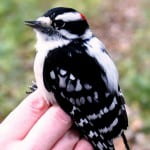
Josh Martinez and I conducted point counts at several Point Sable sites this morning. The sky was overcast and the wind speed was around 10 mph. There were quite a few ducks visible from the end of the Point but none were close enough to identify. The most exciting bird of the day was a Horned Grebe (Podiceps auritus) on the bay just off the outlet of Wequiock Creek. We also saw 3 Hermit Thrushes (Catharus guttatus), a Bald Eagle (Haliaeetus leucocephalus) and several species of woodpecker including a very cooperative Downy Woodpecker (Picoides pubescens; see photo). Overall, it was a very quiet morning for birding.

Distant Horned Grebe on the bay of Green Bay, October 26, 2011

Male Downy Woodpecker, Point au Sable, October 26, 2011.
By:
Vicki Medland
|
Published:
October 5, 2011
Winds of up to 69 mph swept through Door County on Thursday, September 29th causing extensive damage, especially on the west side of the county. Thousands were without power for two days and Highway 57 between Jacksonport and Baileys Harbor was closed through Saturday. All the state parks located in the county were closed for the weekend.
Toft Point natural area, managed by the Cofrin Center for Biodiversity, is located in Baileys Harbor, WI and was in the path of the windstorm. At least 24 downed or broken trees were counted by the Friends of Toft Point as they inspected the trails on Sunday.

Toft Friend Charlotte Lukes sits on a fallen tree at Toft Point Natural Area. Photo by Roy Lukes.
Josh Martinez, land steward for the Cofrin Center for Biodiversity will be heading up with UW-Green Bay facilities staff to clear the road and trails at Toft Point on Friday, October 7th. We ask that people remain off the trails and road until after trees can be removed to avoid injury from leaning trees and branches.

Trees leaning over the trail at Toft Point. Photo by Roy Lukes.
By:
Vicki Medland
|
Published:
December 30, 2010
We have consolidated our blogs to this single site. You can get where you want by clicking on categories listed in the right hand panel. Please note that the links inthe main menu only return you to our old website. Ths will be changing as we load up our newly redesigned site in a few weeks.